
If your shower loses pressure when another faucet turns on, the plumbing system is usually unable to maintain enough water flow for both fixtures at the same time. Common causes include undersized supply pipes, a partially closed valve, clogged plumbing, a pressure regulator problem, mineral buildup, or insufficient incoming water pressure. The pattern of the pressure drop can help identify the cause.
A small change in shower flow when another fixture opens can be normal. A dramatic pressure drop, especially when it affects several fixtures, usually deserves further investigation.
Why Your Shower Pressure Drops When Another Faucet Is Used
Your home receives water through a main supply line, which then branches off to individual fixtures.
When the shower is the only fixture running, most of the available flow can serve the shower. Turn on another faucet, flush a toilet, or start a washing machine, and that available flow must be shared.
A properly functioning plumbing system should normally handle ordinary simultaneous use without the shower becoming extremely weak.
If the pressure change is substantial, one of several restrictions may be limiting how much water can reach the fixtures.
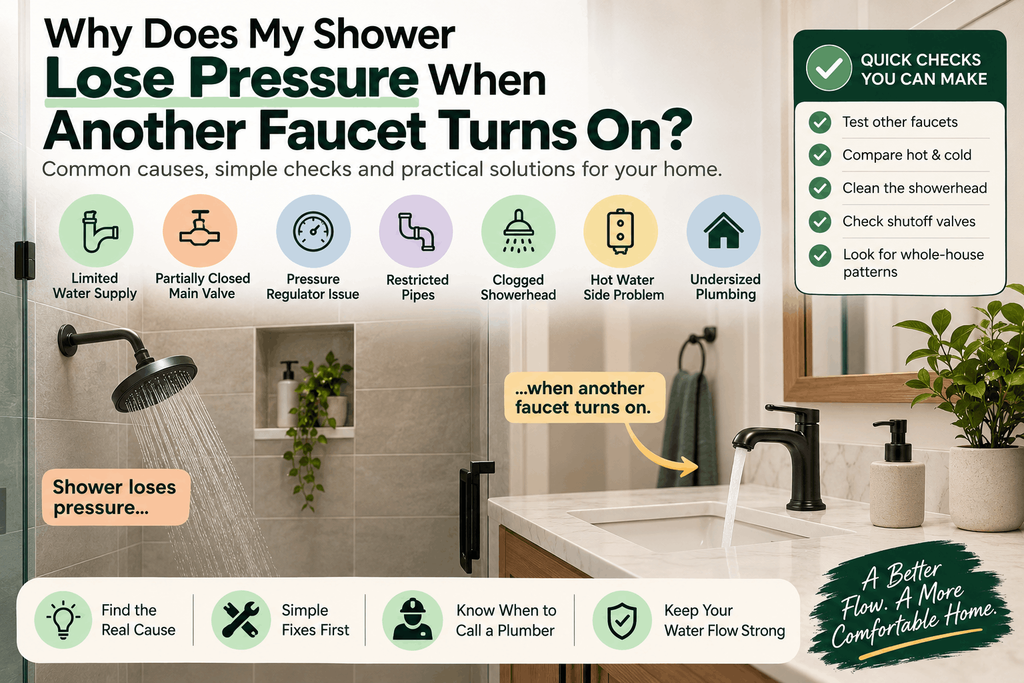
[Internal link opportunity: Why Is My Water Pressure Low in Only One Faucet?]
Most Likely Causes of Shower Pressure Loss
1. The Available Water Supply Is Too Low
The first possibility is simply that your home is receiving inadequate pressure or flow.
When demand increases, the weakness becomes much more noticeable.
For example, the shower may feel acceptable while it is running alone. Once someone opens the kitchen faucet, the shower flow drops because there is not enough available capacity to comfortably supply both fixtures.
This becomes more likely when pressure changes occur throughout the house rather than only at the shower.
2. Your Main Water Shutoff Valve Is Not Fully Open
A partially closed main shutoff valve can restrict the amount of water entering the house.
You might still have apparently reasonable water flow when using one fixture. The restriction becomes more obvious when two or more fixtures demand water simultaneously.
If the main valve was recently operated during plumbing work, checking its position is a sensible early troubleshooting step.
Do not force an old, corroded, damaged, or difficult-to-turn valve. A deteriorated valve can leak or fail and may need professional attention.
3. A Pressure-Reducing Valve May Be Malfunctioning
Some homes have a pressure-reducing valve, often called a pressure regulator, on the incoming water line.
Its job is to control high incoming municipal water pressure and deliver more manageable pressure to the house.
A failing or incorrectly adjusted regulator can sometimes produce noticeable pressure problems, particularly as household water demand changes.
If multiple fixtures throughout the property behave similarly, the pressure regulator becomes more relevant to the diagnosis.
[Potential ad break]
4. The Plumbing Pipes May Be Restricting Flow
Older or restricted pipes can limit how much water moves through the plumbing system.
Internal corrosion, mineral deposits, or other restrictions may reduce the effective diameter of a pipe. One fixture may still receive enough water to appear normal, but simultaneous demand can expose the restriction.
This is particularly important when:
- several fixtures experience pressure changes;
- the problem has gradually become worse;
- certain sections of the home are affected more than others;
- older metal supply piping is present.
Replacing a showerhead will not solve a restriction deeper inside the home’s supply piping.
5. The Supply Pipes May Be Too Small for Simultaneous Demand
Pipe sizing matters because a pipe can only deliver a practical amount of water under the available pressure.
A plumbing layout that supplies several high-demand fixtures through a relatively restricted branch can produce noticeable flow loss when those fixtures operate together.
This possibility is especially worth considering if the problem has existed for as long as you can remember rather than appearing suddenly.
It may also become apparent after a remodel adds or changes fixtures without addressing the existing supply arrangement.
6. The Showerhead or Shower Valve May Be Restricted
If the pressure problem is primarily noticeable at the shower, inspect the shower itself before assuming the entire home has a plumbing problem.
Mineral deposits and debris can restrict showerhead openings.
A shower mixing valve or cartridge can also develop problems that affect flow.
A restricted shower may seem reasonably usable when no other water is running, but another fixture can make the weakness much more noticeable.
[Internal link opportunity: How to Fix Low Water Pressure in a Shower]
7. The Problem May Be Limited to Hot Water
Pay attention to whether the pressure loss happens with:
- cold water;
- hot water;
- or both.
If the shower mainly loses flow while using hot water, the problem may be somewhere on the hot-water side rather than with the home’s entire water supply.
That distinction can substantially narrow the troubleshooting process.
What Your Symptoms May Be Telling You
| Symptom | Possible Cause | What to Check First | Recommended Action |
|---|---|---|---|
| Shower weakens whenever any faucet opens | Low incoming supply, main valve restriction, regulator issue | Test several fixtures | Check whole-house pressure behavior |
| Only the shower becomes very weak | Showerhead, cartridge, shower valve, or branch restriction | Showerhead and nearby fixtures | Clean showerhead and compare flow |
| Pressure problem occurs throughout the house | Main supply, regulator, shutoff valve, or supply piping | Main valve and multiple fixtures | Consider professional diagnosis |
| Problem is mainly on hot water | Hot-water-side restriction | Compare hot and cold flow | Investigate hot-water plumbing |
| Pressure has gradually worsened | Mineral buildup, corrosion, aging valve/regulator | Look for a whole-house pattern | Have persistent restrictions evaluated |
| Problem began after plumbing work | Valve position, debris, or installation issue | Recently serviced area and valves | Contact the installer if necessary |
| Pressure has always dropped with simultaneous use | Pipe sizing or supply capacity | Plumbing layout and household demand | Consider whether system capacity is adequate |
Quick Checks You Can Make Before Calling a Plumber
You can learn quite a bit about the problem without opening walls or dismantling your plumbing.
Test Different Faucets
Run the shower at its normal setting.
Then have someone turn on fixtures individually:
- bathroom sink;
- kitchen faucet;
- another shower;
- washing machine supply;
- toilet.
Watch what happens each time.
A pressure drop caused by nearly every fixture suggests a broader supply problem. A problem triggered by one particular fixture or area can point toward a shared branch of the plumbing system.
Compare Hot and Cold Water
Run the shower cold and observe its flow.
Then test it at a warmer setting.
A significant difference between hot and cold operation can help determine whether the restriction is related to one side of the plumbing system.
Compare the Shower With Nearby Fixtures
If the shower becomes weak but the bathroom sink remains relatively strong, the restriction may be closer to the shower itself.
If the entire bathroom weakens together, the problem may be farther upstream.
This simple comparison helps you determine whether you are dealing with:
- a single-fixture problem;
- a branch-line problem;
- or a whole-house problem.
[Internal link opportunity: What Causes Low Water Pressure Throughout a House?]
Inspect the Showerhead
Remove the showerhead only if it can be done safely without damaging the fitting.
Check for visible mineral deposits or debris.
Cleaning a clogged showerhead is one of the simplest homeowner-level fixes, but remember that it only addresses restrictions at the showerhead itself.
If the shower still has poor flow without the showerhead attached, the restriction is likely elsewhere.
Check Accessible Shutoff Valves
Check whether relevant accessible water valves appear fully open.
Pay particular attention if the problem started immediately after repairs or maintenance.
Avoid forcing valves that are seized, badly corroded, leaking, or difficult to operate.
[Potential ad break]
Step-by-Step Troubleshooting
Instead of replacing parts randomly, diagnose the problem from the largest area to the smallest.
Step 1: Determine Whether the Problem Is Whole-House or Shower-Specific
Test several fixtures.
If pressure falls substantially everywhere when a second fixture opens, investigate the home’s main water supply, regulator, valves, and piping capacity.
If the shower is the main problem, move closer to the shower itself.
Step 2: Determine Whether Hot and Cold Water Behave Differently
A problem affecting both hot and cold water points toward a shared supply issue.
A problem concentrated on one side can help isolate the affected plumbing.
Step 3: Remove an Obvious Showerhead Restriction
Inspect and clean the showerhead.
Then retest the shower while another faucet is running.
If performance improves significantly, buildup at the showerhead was contributing to the problem.
If nothing changes, continue troubleshooting.
Step 4: Look for a Shared-Branch Pattern
Pay attention to which fixture causes the largest change.
For example, suppose the shower remains reasonably strong when the kitchen faucet runs but becomes very weak when the nearby bathroom sink opens.
That pattern could indicate that the shower and bathroom sink share a restricted portion of the supply plumbing.
It does not prove where the restriction is, but it gives a plumber much more useful diagnostic information.
Step 5: Consider When the Problem Started
The timing matters.
Sudden pressure loss may point toward:
- a valve that was recently operated;
- debris entering a fixture or valve;
- a regulator problem;
- recent plumbing work;
- or another new restriction.
Gradual deterioration makes buildup, corrosion, or an aging plumbing component more plausible.
A problem that has always existed makes pipe sizing, system design, or supply capacity more relevant.
Step 6: Have the Water Supply Pressure Evaluated if Necessary
If several fixtures are affected, checking actual water pressure can help separate a fixture problem from a broader supply problem.
A qualified plumber can evaluate pressure under static conditions and while water is flowing. The comparison can provide more useful information than simply saying the shower “feels weak.”
[Internal link opportunity: How to Check Your Home’s Water Pressure]
A Simple Diagnostic Decision Tree
Use this sequence to narrow the problem:
Does only the shower lose significant flow?
If yes → inspect the showerhead, shower valve/cartridge, and shower branch supply.
If no → continue.
Do several fixtures become weak whenever another fixture starts?
If yes → investigate the main shutoff, pressure regulator, incoming supply, and pipe restrictions.
Is only hot water noticeably affected?
If yes → investigate the hot-water side of the system.
Did the problem begin after plumbing work?
If yes → check accessible valves and consider debris or an installation-related restriction.
Has the problem existed since you moved in or since a remodel?
If yes → pipe sizing and plumbing layout may be contributing factors.
Is This Actually a Pressure Problem or a Flow Problem?
Homeowners often describe any weak stream as “low water pressure,” but pressure and flow are related without being exactly the same thing.
A restriction can allow adequate pressure to exist when no water is moving while limiting the volume of water available once several fixtures are operating.
That is why a shower can seem perfectly acceptable until another faucet turns on.
The distinction also explains why measuring only the resting pressure does not always reveal the complete problem. How the system behaves while water is actually being used can be equally informative.
What Can You Reasonably Fix Yourself?
Reasonable homeowner checks may include:
- cleaning mineral deposits from an accessible showerhead;
- comparing hot and cold flow;
- testing different fixtures;
- checking whether an easily accessible valve appears fully open;
- documenting which fixture causes the largest pressure drop;
- checking whether the problem started after recent plumbing work.
These observations can solve simple problems or make professional diagnosis much faster.
More invasive plumbing work should not be treated as trial and error.
Replacing supply pipes, servicing certain pressure regulators, opening concealed plumbing, replacing shower valves, or modifying the main water supply is generally better left to a qualified plumber.
When Should You Call a Plumber?
Professional diagnosis is appropriate when the shower pressure loss is severe, persistent, or clearly part of a larger plumbing problem.
Consider professional help when:
- several fixtures have poor flow;
- the problem suddenly appeared without an obvious explanation;
- an old valve is leaking or badly corroded;
- you suspect restricted or deteriorating pipes;
- the pressure regulator may be malfunctioning;
- the shower valve appears to be the problem;
- hot-water flow is substantially different from cold-water flow;
- the problem requires opening walls or modifying supply piping.
You should also investigate unexpected pressure changes accompanied by signs of leakage, such as unexplained dampness or water appearing where it should not.
[Internal link opportunity: Signs of a Hidden Water Leak in Your Home]
[Potential ad break]
How to Prevent Shower Pressure Problems
Not every pressure problem is preventable, particularly when the cause is municipal supply or an older plumbing layout. However, several habits can reduce avoidable restrictions.
Keep Showerheads Clean
Mineral deposits can gradually restrict small showerhead openings. Periodic cleaning helps maintain normal spray performance.
Pay Attention to Gradual Changes
A slowly weakening shower is easier to investigate before it becomes severe.
Notice whether the problem affects:
- one fixture;
- one bathroom;
- hot water only;
- or the entire property.
That pattern is useful diagnostic information.
Avoid Forcing Aging Valves
Older plumbing valves can deteriorate.
If a valve is difficult to operate, forcing it may create a leak or turn a manageable pressure problem into a more urgent repair.
Consider Plumbing Capacity During Renovations
Adding high-demand fixtures or changing a bathroom layout can alter how the plumbing system behaves.
During major renovations, the existing water-supply layout and pipe capacity should be considered rather than assuming the old arrangement will adequately serve every new fixture.
Frequently Asked Questions
1. Why does my shower lose pressure when another faucet turns on?
Your shower loses pressure when another faucet turns on because both fixtures are competing for the available water flow. A slight change can be normal, but a major drop can indicate restricted pipes, a partially closed valve, insufficient supply, a pressure regulator issue, or a restriction near the shower.
2. Why does my shower pressure drop when the toilet flushes?
A flushing toilet temporarily demands additional cold water. If the shower and toilet share a restricted supply branch, or the home’s overall water delivery is limited, the shower flow can noticeably decrease while the toilet tank refills. A severe or persistent drop suggests the plumbing system should be checked for restrictions or supply limitations.
3. Can a bad pressure regulator cause shower pressure to drop?
A malfunctioning pressure regulator can contribute to inconsistent or inadequate water pressure throughout a home. It becomes a stronger possibility when multiple fixtures are affected rather than only the shower. Because regulator diagnosis and adjustment involve the home’s incoming water supply, professional evaluation is appropriate if basic fixture checks do not identify the problem.
4. Why does only my shower lose pressure while other fixtures seem normal?
If other fixtures remain strong, the restriction may be relatively close to the shower. A clogged showerhead, shower cartridge or mixing-valve problem, or restricted shower supply branch could be responsible. Start by comparing hot and cold flow and inspecting the showerhead before assuming there is a whole-house pressure problem.
5. Can old pipes cause water pressure to drop when two faucets are running?
Yes. Older pipes can develop internal corrosion or mineral buildup that reduces the space available for water to flow. A restricted pipe may provide acceptable flow to one fixture but struggle when multiple fixtures operate simultaneously. Determining whether concealed supply pipes are restricted usually requires more investigation than simply cleaning faucets or showerheads.
6. Why is my shower pressure fine until someone uses water elsewhere in the house?
This pattern suggests your shower can receive adequate flow when demand is low but the plumbing system struggles when another fixture requires water. The cause may be limited incoming supply, pipe restrictions, undersized branches, a partially closed valve, or a regulator issue. Testing several fixtures individually can help determine whether the limitation is local or house-wide.
Suggested Internal Links
- Anchor text: “low water pressure in only one faucet”
Suggested article: Why Is My Water Pressure Low in Only One Faucet? - Anchor text: “low water pressure throughout the house”
Suggested article: What Causes Low Water Pressure Throughout a House? - Anchor text: “fix low water pressure in a shower”
Suggested article: How to Fix Low Water Pressure in a Shower - Anchor text: “check your home’s water pressure”
Suggested article: How to Check Your Home’s Water Pressure - Anchor text: “signs of a hidden water leak”
Suggested article: How to Tell If You Have a Hidden Water Leak
